
The last days of your Womb Life
Unless you were born prematurely you will have spent between 37 and 42 weeks in the womb. You have been on an amazing journey from a tiny single cell to an estimated 1.25 to 26 trillion celled being at birth. Now, your familiar world is about to change as you are about to embark on a new journey, your biggest adventure since you arrived into your physical body.
Lets first take a closer look at you at this stage of your development before you start the process of being born.
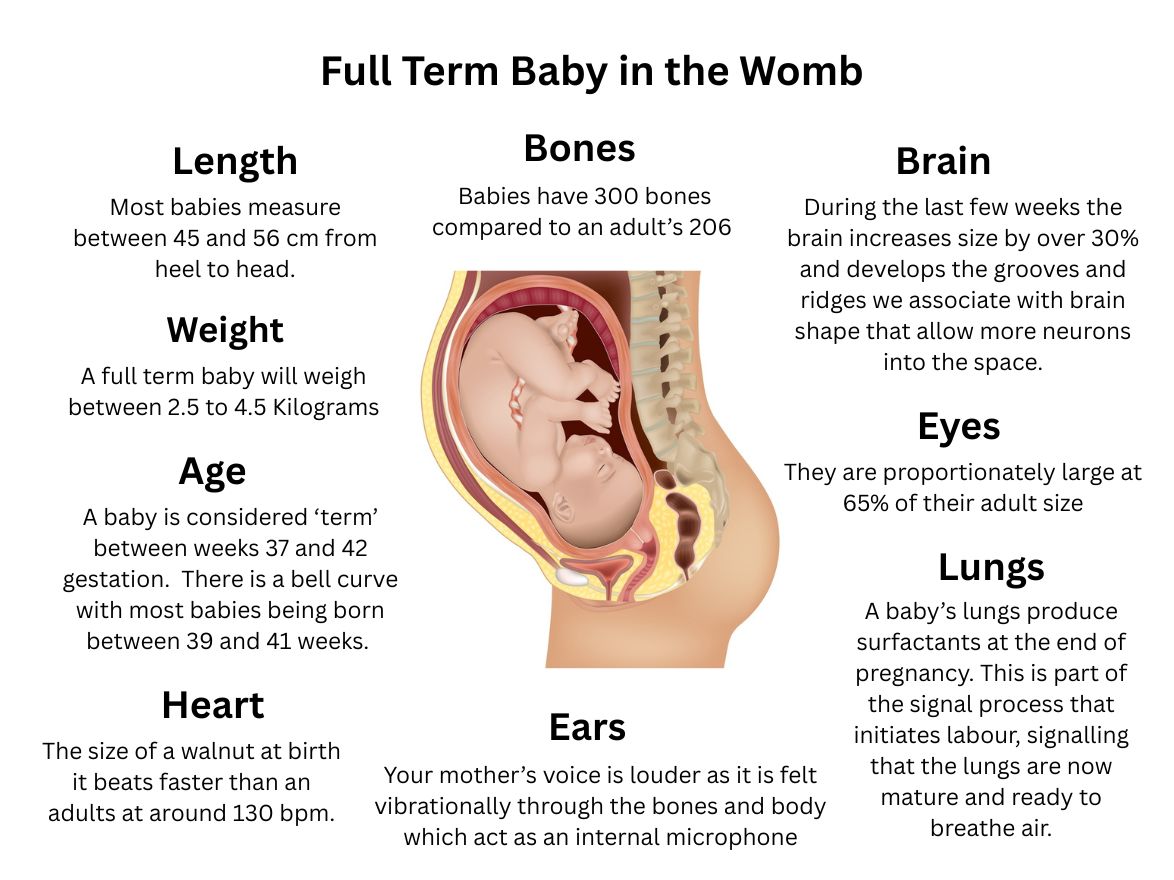
Heart
By the time she is ready to give birth, your mother’s heart has grown new muscle mass. increasing the mass of the left ventricle by up to 50%. Her blood volume has increased also by up to 50% in order to support both of you. Meanwhile, your heart which was beating at a maximum of 150-170 times a minute, slows to around 130-40bpm. This is slower but still faster than an adults. The foetus has a naturally faster heart rate due to the amount of energy they are expending to grow their body. This requires the higher metabolism and heart rate to circulate blood, oxygen, and nutrients, as well as to remove waste products.
Bones
The developing baby has 300 bones compared to an adult as many will harden and fuse together over time to form the 206 bones of an adult human. The skull has several bony plates that are joined by flexible fibrous joints called sutures and have multiple gaps called fontanelles. This allows for the baby's head to be moulded during birth so it can pass through the birth canal more easily. The head can often appear temporarily misshapen or elongated after birth. These bones fuse together to their permanent shape over 4 to 26 months.
Brain
Their brain weighs about 370 grams (or 13 ounces). This is around 10-12% of its body mass. Which means it is proportionally much larger than an adults brain that weighs about 1300-1400g (46-49 ounces) and is only about 2% of total body mass. There are about 100 billion neurons in the baby's brain at birth.
Lungs
The babies lungs start to develop at 4 weeks and baby can ‘breathe’ at 10 weeks. At 6 months they start producing surfactant which will help prevent the lungs collapsing when they breathe air for the first time. These surfactants are also believed to play a direct role in initiating labour by signalling maturity of the lungs ready for breathing air. However, the lungs are one of the last organs to mature and are not fully mature until the child reaches around 8 years old.
Sleep
The foetus at this stage sleeps up to 95% of their time (though this is difficult to study accurately) for about 40-50 minutes at a time. No-one knows why this rhythm, but we do know that babies enter the deep REM state from about 26 to 28 weeks and for most of those early weeks they spend much of their sleep state in the REM state. They movie between Rem (active sleep) and non REM sleep about every 20 -40 minutes. It is postulated this is important for their brain development and they may be dreaming about their experience.
Hearing
The womb is quite noisy with the mother's heart beat a constant along with sounds of her breathing, the whoosh of her blood, digestion, voice and other sounds of life outside the womb. External sounds are muffled by the amniotic fluid that fills the ears and the presence of the mother's body. These sounds resemble what we would hear if submerged under water. Your mother's voice is louder to baby you because it travels through her bones and body, reverberating like an internal microphone. They learn to recognise her voice and show a clear preference for it once born. Whilst there is a stronger preference shown for the mother's voice in studies, there is also a recognition of the father or other close family member's voice and it can also, depending on the relationship, be a calming familiar sound.
Eyes
Whilst they began as outgrowths of the brain at 6 weeks, by birth the eyes are fully functional. They are proportionally large at 65% of their adult size but their vision is blurry at this time. The first colour the eyes are able to see is red, which is possibly due to this colour being predominant as light filters through the flesh of the uterus.
Time to be born
This womb life as you know it is about to come to an end with the onset of labour which marks your second transition or rite of passage (the first being conception).
Although in modern times your mother would be assigned a 'due date' which in the UK and much of the modern world is set at 40 weeks, there is in reality a window of about a month when baby you may be born. Although we don't have a complete understanding of the full system at work here is a summary on what we know about how labor starts.
Inside the body - the processes at work
As the baby reaches maturity there is a complex dialogue between the baby and their mother that triggers a number of hormonal and mechanical events that culminate in the beginning of labour. Mostly it is thought that the baby is the main trigger and the mother's body responds to the signals the baby sends.
The baby's signal process includes:
- Organ maturation- the brain and lungs in particular mature ready for life outside the womb and they release biochemical signals.
- Protein release - The lungs release surfactants into the amniotic fluid that are a signal of maturity and initiate the birthing process.
- Stress and Cortisol- The reduced space causes a mild stress response that triggers the adrenal glands to produce cortisol
The placenta and the mother respond to these signals and a positive feedback loop is created:
- The placenta increases its production of CRH (Corticotropin-Releasing Hormone ) which acts as a "clock" triggering both further foetal cortisol production a reduction in progesterone (which maintains pregnancy) and a rise in oestrogens. The oestrogens increases the uterus sensitivity to contractions and increasing oxytocin receptors, and causing cervical ripening.
- Prostaglandins are produced by both the placenta and the foetus and these help soften the cervix and initiate uterine contractions.
- Relaxin: Produced by the placenta and ovaries, relaxin levels increase to soften the cervix, remodel connective tissue, and relax the ligaments of the pelvis.
- Increased Receptors: the mother increases oxytocin receptors towards the end of pregnancy and oxytocin (popularly dubbed the love hormone) stimulates contractions. Simultaneously her uterus is also becoming less responsive to progesterone and the levels of oestrogen are rising.
- As the uterus contracts he baby's head is pushed against the cervix which stimulates the mother's pituitary gland to release oxytocin which further stimulate contractions
Ok, yes, it is complex! Bottom line is it is a finely tuned system of communication that causes the cervix to 'ripen', meaning to thin, soften and dilate and the uterus to contract. Generally, the mother will notice the onset of labour as irregular tightenings that resemble period pains that gradually become stronger, longer and more regular.
This system utilises the hypothalamic-pituitary-adrenal (HPA) axis of both mother and baby. The HPA axis is the central response system regulating how the body handles stress and is involved in regulating many body systems including digestion and mood. When mother and baby are relaxed and confident, the hormones flow and the process works wonderfully well and is incredibly powerful. However, when there are stressors present the whole system can be knocked off balance, labour can stall, stop or never get started in the first place as the sympathetic nervous system kicks in.
What happens when there are stressors impacting initiation of labour?
Firstly, What constitutes a stressor?
I imagine you are familiar with the analogy of the tiger threat? Where a very real physical threat to your safety initiates processes in your body that will help you survive. In our modern world we often have this process activated by a different type of threat that is triggered by thoughts, worries and anxieties that are less easily linked to obvious physical threats. But the system activates the same. This same process applies to labour including the initiation of labour. Physical substances can also act as stressors on the system or as an interfering signal.
I would categorise the stressors that the baby you faces into internal and external stressors.
Internal stressors include baby’s own thoughts and emotions in response to his/her journey so far, causing their system to emit particular hormones and signals which their body will respond to accordingly.
External stressors are made up of every signal from the outside environment which includes the mothers thoughts and emotions in response to her own environment which may include worries about other family members, money, the information care providers are sharing and the physical environment itself.
Both the baby and mother from an evolutionary perspective are expecting calm , dark , warm, safe and familiar environment. Anything departing from that can activate a state of alert that is the opposite of what is needed for the hormonal flow that is crucial for the birth hormones and labour itself to progress smoothly.
Unfortunately in the modern world, far too often we have deviated from the ideal conditions needed for smooth birth. And it often starts with the pressure to ‘deliver’ the baby by a certain arbitrary date followed by procedures to start labour artificially when that date passes.
What are the potential results of stress?
Under stress the sympathetic nervous system is activated, priming you for action to keep you safe from the threat and not for giving birth. This includes the production of adrenalin, cortisol, and diversion of blood away from the organs needed for labour and towards muscles, heart, and brain to prepare the body for "fight or flight". This can result in:
- Labour doesn’t start at all.
- Labour starts but then stalls.
- Labour starts early – baby seems determined to come fast.
- Labour goes too fast which can lead to tearing and shock for both mother and baby.
As a generalisation, if the sympathetic nervous system is activated earlier in the process, labour is likely to stop or stall. If it happens later in labour, it is more likely birth will speed up. Imagine the situation of a mother facing a tiger whilst in labour. If she is earlier in labour, and birth is not imminent, she will want to run to a place of safety before giving birth. In that situation labour will stall or stop to answer that need. If labour is more advanced and the baby is closer to arriving, then she will want to give birth as quickly as possible so that she can pick up her baby and run to a place of safety. The body will respond appropriately again and precipitate the labour.
As you can see, with the combination of beautifully orchestrated systems working to different ends where there are adverse circumstances largely outside the babies direct control there can be a potential for some interesting dynamics to occur… The way labour started for you and your experience of the process often plays directly into your approach to starting things in your life today. It may also link to how you experience and handle changes in life. We will be working with these themes and the physical process of going into labour in our live call this week.
For now it is time to reflect on this stage in your development with some journal questions.
Let’s reflect
1. How did your mother go into labour? Were you early or late or was your mother induced?
2. Did you feel ready to be born?
3. Moving focus to you now. Consider your habitual way of starting new projects, do you leap in with enthusiasm and then falter, Do you start steady and continue steady, do you have difficult starting at all?
4. How do you respond to changes in life? Particularly changes related to your home or changes that will lead to a change of environment?
5. Where do you see natural strengths in how you approach new situations and projects and where do you struggle?
6.Then take a few moments to reflect on your answers to Q 3-5. How might your birth story be playing into these patterns? What insights arise as you consider how you were born alongside these patterns?
Remember, if you don’t know anything consciously about your birth, sit quietly for some minutes and ask your body / baby you/Higher Self to show you.