This week we will be focusing on conception. The beginning of your Soul's journey to human life in a physical body.
The lesson contains both a video and a text explanation of the topic. Both cover the same ground but are intended to support various learning styles and preferences. We start with a scientific perspective of conception and end with a journaling exercise. The journaling questions start at 16 minutes 35 seconds.
A quick note before we begin:
Here we will start with an overview from a scientific perspective. Of course the science is mostly about measuring and defining at the level of hormones, mechanics and processes and we are considering this journey from a more holistic, whole picture including the energetics and the resulting implications for our lives and living in fulfilment now. But the science gives us helpful understanding about what is involved in the process that can support us to experience and heal the journey we went on to grow our body and come into physical form.
I invite you to follow along with the science perspective but with an open curiosity of what the understanding may reveal to you about your journey to becoming you.
Let's begin:
In every day language, we often use the term conception interchangeably with getting pregnant. In biological terms, conception is the fertilisation of the egg (oocyte) by the sperm which fuses into a single cell called a zygote. This single cell divides and travels down the fallopian tube. The official marker of pregnancy is after around 6 to 10 days when the now bundle of cells called a blastocyst implants into the uterus.
This period of time-, from release of the egg, fertilisation and the initial few days of cell division is the time period we will be focusing on specifically this week.
Let's look a little closer at what happens during this fascinating initial journey.
On the female side -The Egg
The egg that will become you has been waiting a long time! It was formed whilst your mother herself was growing in her own mother- your grandmother's womb. There are three stages the egg goes through.
1 Primary Oocyte- The immature egg with 46 chromosomes remains dormant in a state of hibernation inside your mother's ovary until just before ovulation. During ovulation a mix of hormones prompts the egg to mature. The primary oocyte undergoes meiosis, a process that splits the full 46 chromosomes in the oocyte ( cells with 46 chromosomes are called diploid cells) into two leaving only 23 chromosomes ( a haploid cell.) The other 23 chromosomes float off to the side and become something known as a polar body that is later reabsorbed into the mother's body.
2. Secondary Oocyte. The ovulated egg with 23 chromosomes is called a secondary oocyte. It's transformation again pauses whilst it waits to be fertilised. The egg will live for only 12 to 24 hours if it is not fertilised.
3 Ovum This is a brief transitional stage that completes the meiosis upon the penetration by the sperm. This mature ovum will quickly be fused with the sperm to create the diploid cell known as a zygote, the beginning of your body.
On the male side- The sperm.
In contrast, the sperm, a haploid cell with 23 chromosomes, can live for 5 days. It must travel to meet the egg in the fallopian tube during this short window of time that the egg is fertile and available. There are a fair few challenges for the sperm that undertake this journey. They must navigate thick fluids, multiple dead ends, and potential hostile immune cells. They are helped though by uterine contractions that guide them towards the fallopian tubes and throughout there is complex communication between the female body and the egg herself and the sperm.
Of the 40 to 300 million that start the journey only a million make it as far as the uterus and only a few hundred to 1000 sperm make it up the fallopian tube towards the egg. Only a couple of hundred make it as far as the egg itself. And only one of these select few can be successful in the next task of fertilising the egg.
The journey of the sperm.
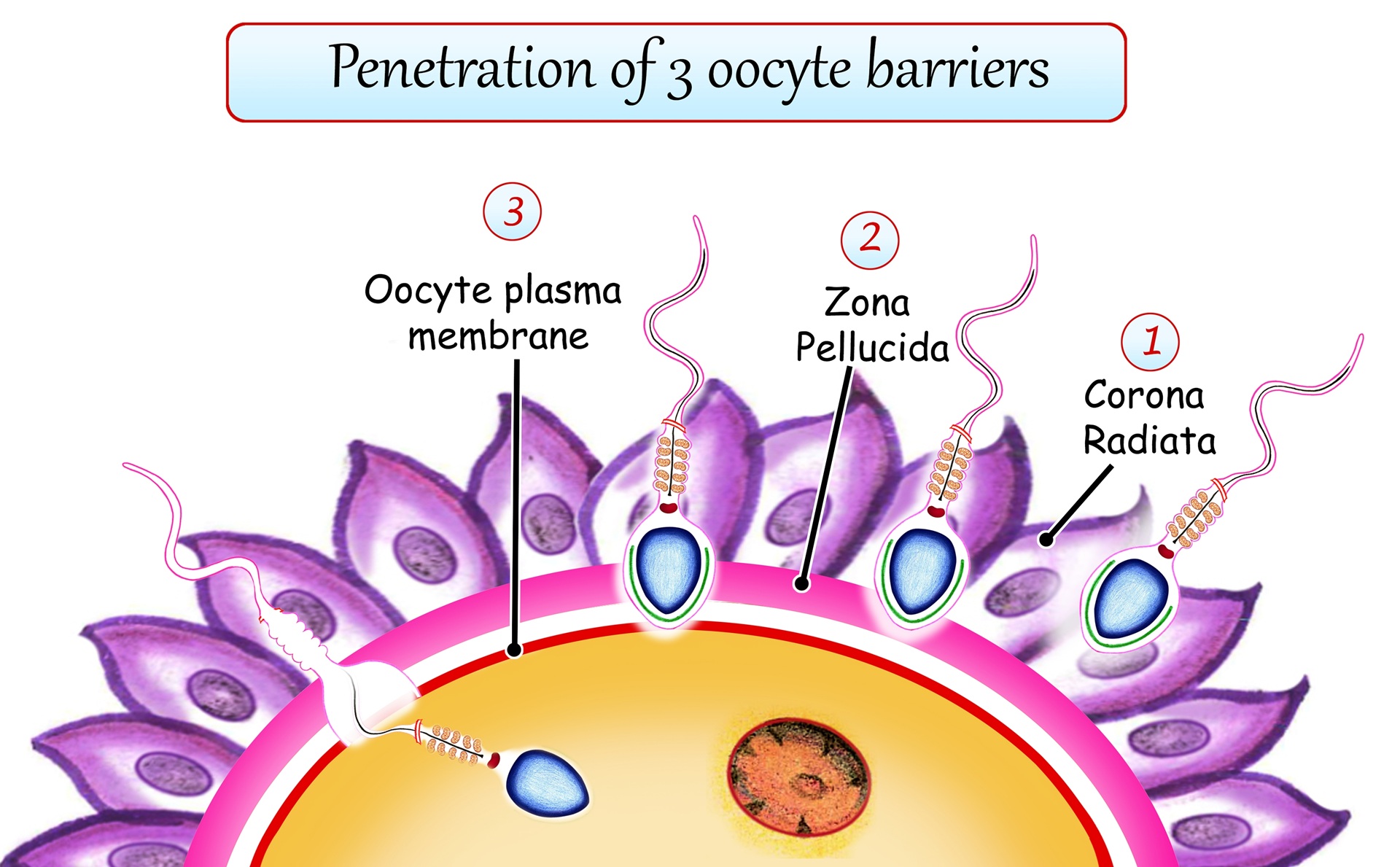
The environment of the vagina triggers physical and biochemical changes in the sperm that prime it to be more active and be ready to release enzymes during fertilisation. It will need this vigorous swimming style and whiplash tail movements for the power to pass through to the centre of the egg and fertilise it. There are three main layers to get through.
1, The Corona Radiata
On reaching the egg, the first layer to navigate is the corona radiata which is the outer layer of follicular cells that protect and nourish the egg as it travels down the fallopian tube.
2. The Zona Pellucida
Beneath this outer layer is the Zona Pellucida- a t thick , transparent membrane that plays a crucial role as a barrier that prevents multiple sperm from fertilising the same egg. The sperm head binds to this layer and triggers the acrosome reaction. This reaction causes strong digestive enzymes to be released and these create the hole in the zona pellucida allowing the sperm to burrow deeper.
3. The Plasma Membrane
Once through the sperm now makes contact with the plasma membrane a thinner membrane that is the direct living boundary of the egg, The membrane of the sperm and egg fuse and the nucleus of the sperm with all the genetic material is released into the egg, leaving the tail behind. This part triggers the hardening of the zona pellucida to ensure no other sperm can get through.
Fusion and creation of the Zygote.
Once these three stages are passed, the nucleus of the sperm and egg are now able to fuse together and create the single cell body called a Zygote. This zygote has the complete set of 46 chromosomes and all the genetic information that will develop into the body that you are in now. This single cell is your smallest physical manifestation of yourself!
The diagram below illustrates this journey.
Cell Division and the continuing journey of your new body.
Fertilisation usually happens in the ampulla which is the widest and longest section of the fallopian tube. The zygote remains as a single cell for at least 12 hours before beginning the process of cell division (mitosis). The cell grows, copies its DNA, separates those copies, and divides into two identical, functional units and this process then repeats over and over. During initial division the growing body stays in the section for about 30 hours whilst the uterus prepares for pregnancy before moving more rapidly towards the uterus in the narrower isthmus part of the fallopian tube.
After three days there are 16 cells and your body is now called a morula.
By day 6 or 7 the bundle of cells is still tiny, the size of a pin head and is known as a blastocyst It resembles a tiny hollow, fluid filled ball made of about 100 to 200 cells. It is composed of the inner cluster of cells which will become the embryo, the outer layer of cells forming the cell called the trophectoderm which will become the placenta and the blastocoel which is the fluid filled cavity. It is still protected by the zona pellucida until it implants at which point is burst out of the protective layer and implants into the lining of the uterus.

During this process, although the sperm is the more obviously active protagonist neither the egg nor the woman's body are submissive passive partners. There is complex communication between the woman, the egg and the sperm. The woman's body reduces the acidity of the vagina to provide a more friendly environment and the cervical mucus both thins to aid swimming and nourishes the sperm on their journey.
The egg plays a significant role in which sperm is successful.
Most of us were taught in school that the fittest and strongest sperm wins the race but recent science tells us a more nuanced story than that.
A recent study in 2020 showed that the egg has an input in to which sperm are successful. The egg releases chemoattractants ( signalling molecules) into the follicular fluid which influence how the sperm swim. The study showed that:
"Follicular fluid from one female was better at attracting sperm from one male, while follicular fluid from another female was better at attracting sperm from a different male…. This shows that interactions between human eggs and sperm depend on the specific identity of the women and men involved." Says Professor John Fitzpatrick assistant professor in the department of zoology at Stockholm University in Sweden and co author of the 2020 study this is quoted from. Chemical signals from eggs facilitate cryptic female choice in humans published in the scientific journal Proceedings of the Royal Society B.
Fascinating stuff. From the body consciousness perspective the egg is probably seeking a genetically diverse match that will produce the strongest offspring. And she didn’t necessarily favour the sperm from her actual partner….
From our perspective here, where we are looking at the energetics of our birth blueprint and using this focus as an opportunity to transform our experience as a human for the better – I suggest allow this information to sink in and be curious and open about your Soul’s experience of the journey of conception.
The spark of life
I’ve often wondered when exactly the soul enters the physical body – is it an instant moment or is it spread out over time. I suspect both as I feel we have a wider awareness as a soul and a different relationship with space, time and matter than we can comprehend as humans.
That said… there is a moment during fertilisation where a spark of light flashes that can be measured with a fluorescent probe. As the sperm enters the egg, there is a release that floods the area around the egg with zinc. Physiologists think that the zinc helps to strengthen the egg membrane to stop additional sperm from getting into the egg. Which is undoubtably true and I wonder what else is happening in the burst of energy beyond our scientific measurements and attempts to understand?
Here are a couple of short videos that illustrate this spark and for those interested provide more detailed information.
Links to videos:
Click this link to view the spark in action (11 seconds)
For a more in-depth look at the science check out this TEDEx talk (14 minutes)
Journal Questions
Take some time now (maybe 15 minutes or so) to reflect on the information around conception that you have received. Here are some question prompts to help you. Make sure you are comfortable and have a drink of water or other refreshment and a pen and paper to capture your reflections. Ensure you will be in a quiet space without disturbance for the time of the exercise. You may have considered your conception in the Birth Blueprint Live course, and now I encourage you to visit it freshly having read some additional facts and see what surfaces for you.
Let's begin.
1.Do you have a known story of conception that you are aware of?
For example, I know that my mother was told she could not conceive naturally and was exploring her options and so her pregnancy was a total surprise to her and I had been there for some time without her realising. If you have any information about your own conception write that down in one or two sentences.
2. As you absorb the accompanying information on conception in this lesson, what feelings or sensations arise in you?
Allow yourself to connect with this time in your consciousness and what surfaces? Again write one or two sentences. Don’t think too hard or search too deeply. Just notice what arises to the surface and allow your pen to write.
3. What beliefs and identity patterns began to form in relation to your unique conception journey?
Allow yourself to write freely without worrying if it makes sense, just write a few sentences or a paragraph and then spend a few moments reading it over and noticing your response to what you have written.
4 What would your Soul love you to know about your conception?
Again, please spend some quiet time allowing your Soul to communicate with you through written word or sensations and feelings that you can then capture in your writing.
Having completed this exercise, take a few breaths and invite whatever has surfaced to settle and come to the live call this week ready to explore further. Please share in the facebook group any insights or thoughts.
Remember you have the guided visualisation in the resources section for support if you wish between this lesson and the live call.