
You can enjoy this lesson in video format and or text format. If you are following along with the text there are illustrations. The lesson covers implantation and some key developments in the womb and ends with some reflection questions.
The Continuing Journey - Implantation
In last week's lesson we followed the journey of the egg and sperm as it fused into a zygote and then started cell division until it was a bundle of cells known as a blastocyst. In this lesson we will look a little closer at the science of implantation, followed by the continued growth of the baby through the embryonic stage, to the foetus. Implantation is the process where the blastocyst that is made up of between 32 and 256 cells implants into the lining of the womb (endometrium)– at around 6 to 10 days after fertilisation.
Implantation marks the official start of pregnancy. Bonding and connection are powerful themes running throughout the birth journey and this is the moment when you form a physical blood connection with your mother for the first time. A connection that will remain intact throughout the pregnancy only ending with your birth. For the remainder of pregnancy you will be both physically joined and energetically housed within the energy field of your mother.
Implantation is also a vulnerable stage. Something like two thirds of pregnancies are lost at this stage often without the mother ever knowing she was pregnant.
The Structure of the Blastocyst
The blastocyst is still contained in the zona pellucida. The zona pellucida has prevented attachment to the fallopian tube and it now gradually thins ready for the next stage.
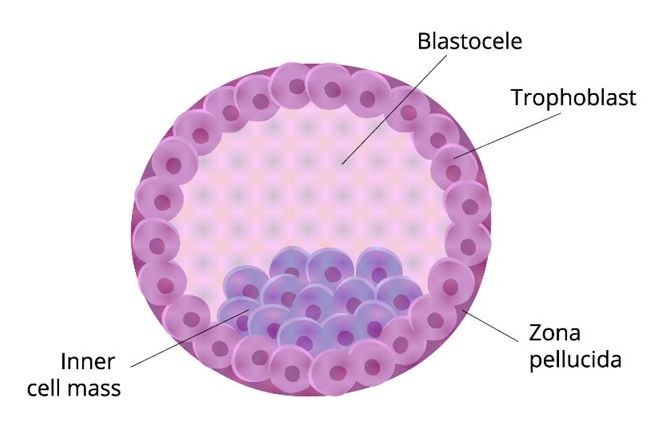
Inner Cell Mass:
The cells inside are already differentiating. They have formed an Inner Cell mass (ICM) also known as the embryoblast, which will become the embryo - the baby you!
Trophoblast:
There is an outer layer of trophoblast cells surrounding the ICM called the trophectoderm which will form the placenta.
Blastocele:
The blastocele is a fluid filled cavity. It provides space for cell migration as the embryo grows, supports nutrient distribution and separates cell layers. It allows the blastocyst to expand, contributing to the thinning of the zona pellucida and hatching process.
The blastocyst, despite its growth is between 0.2 and 0.5 mm in size at the time of implantation.
Stages of Implantation
sdfsfd
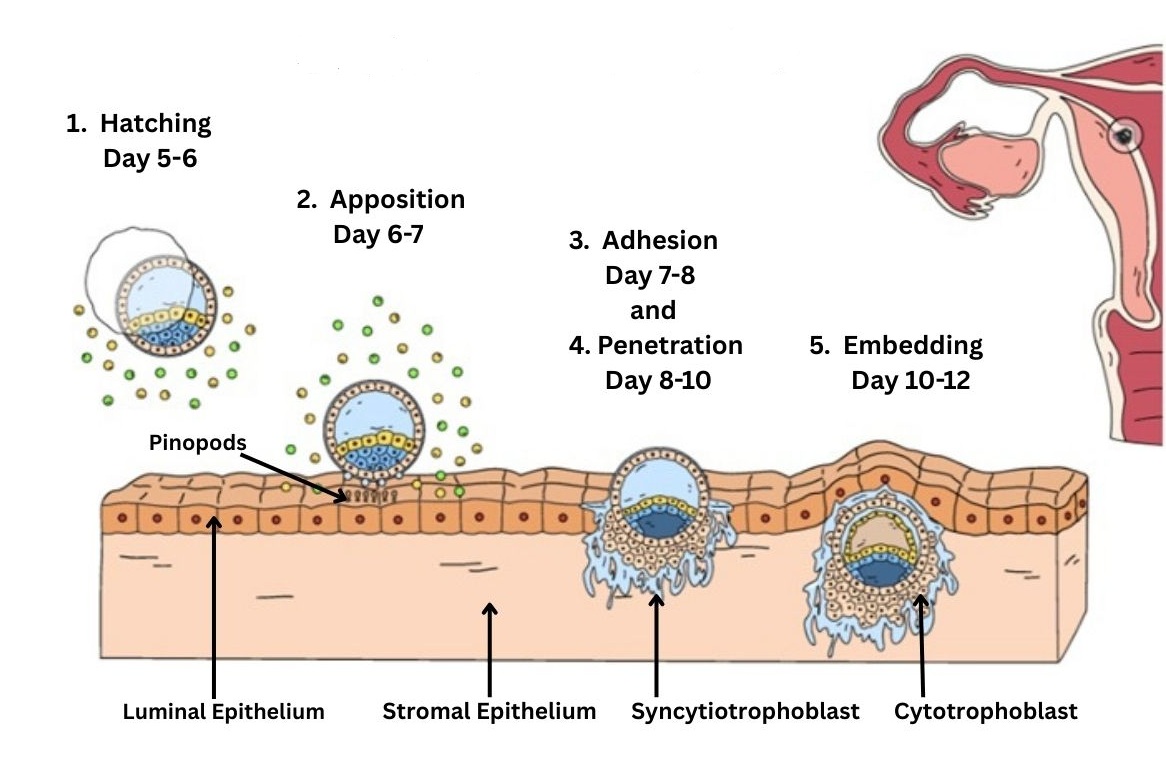
Here are the stages:
1 Hatching:
The growing blastocyst emerges from the zona pellucida on around day 6 so that it can attach to the uterine wall. It usually attaches on the back upper side of the uterus.
2.Apposition
This is the very first loose connection between the embryo and the uterus. It is not yet stable and fully attached.
3. Adhesion
This is a stronger connection that is achieved by protrusions of trophoblast cells. This period involves signalling between the mother's uterine lining and the embryo which initiates changes in the endometrial lining to allow the attachment.
4. Penetration
The trophectoderm cells penetrate more deeply as the embryo breaks through the uterine lining (endometrium) to embed itself into the underlying connective tissue (stroma) and establish a vascular connection with the mother. Once the connection with the maternal blood supply is established the blastocyst is no longer reliant on stored nutrients and uterine secretions and can now receive nutrients and oxygen directly from the maternal blood.
5. Embedding
The blastocyst fully sinks into the endometrium and the surface breach is sealed with a fibrin plug- a mesh like clot. Once embedded development continues more rapidly.
Gastrulation
Gastrulation occurs around week 3. It transforms the blastocyst into a three layered structure that establishes the fundamental body plan and forms the three primary germ layers. A germ layer is a primary layer of cells that later differentiates into specific organs and tissues. These are:
- Ectoderm: The outer most layer will become the entire nervous system, the skin and hair, nails and some sensory organs.
- Mesoderm: This is the middle layer and will become the muscles, bones, cartilage and circulatory system, including the heart and some other inner organs such as the kidneys and sex organs.
- Endoderm: This is the inner most layer and where the liver pancreas, lungs and lining of the digestive tract is developed.
All the major internal organs and external body structures will be formed by week 11 of the pregnancy at which point the embryo is now called a foetus. This first three months is also the most vulnerable time for miscarriage. From the 12th week onwards the focus is on rapid growth and maturing of the function of different organs and systems.
Continuing Growth and key developments in the Womb
Note: Viewpoints on what the baby can remember, feel and sense have changed over the years. Science still holds that certain synapses in the brain need to develop before memory is formed and these synaptic connections form in the second trimester and strengthen in the third. There are many studies in these later months that show the babies' responses in the third trimester as the prefrontal cortex is developing. These show babies demonstrating preferences for sounds, their mother’s voice, and various behaviours in the womb.
My experience and view point. Although there may be validity to some limitations in types of memory that may be possible due to developmental stages and conscious recall of past events may develop later, there are multiple layers and types of memory and consciousness that may be stored in ways we have not been able to measure yet. We can access the consciousness of the egg and sperm for example, as we did last week. As such I am open to information, memories and experiences from any point in the development and not just when the established science can prove that the developing foetus is showing responses we can measure. Or in other words the development of conscious memory and specific developmental stages is not a prerequisite for events being stored in the body and your consciousness and impacting you.
As we continue on the fascinating journey of growing your body in the womb, continue to consider how your journey as an adult may be influenced by your personal story in the womb.
The heart:
The heart is the first fully functioning organ and will start pulsing at about 5 to 6 weeks and is considered fully functioning by 10 weeks. When it first starts pulsating it beats at around 110 beats per minute which increases to between 150 and 170 beats per minute by week 10 before slowing slightly over the later stages of pregnancy. It still remains considerably faster than an adults heart rate though. Just like an adult's heart the foetus emits a powerful electro-magnetic field. The heart's electro magnetic field is the strongest in the body. It is detectable several metres out beyond the adult body. This can be measured and contains information about a person's emotional state. This has become a field of study in both adults and antenatally, with thoughts that the field is used as a method of communication between the mother and her foetus.
The brain:
The brain develops alongside the heart but does not complete its development until after birth. In fact the brain continues to develop until early adulthood. The brain develops from some specialised cells that form a neural plate by third week of conception. This folds around to form the neural tube by week 3 to 4 and the three primary brain regions - forebrain, midbrain and hind brain - begin to form. The first brain waves can be detected by week 6 though the brain is far from complete or mature at this stage. However, by the time the baby is born it will have created 100 billion neurons. This equates to 250 000 nerve cells a minute during pregnancy. During the first trimester the brain makes up more than half of the foetus' weight, a proportion that gradually lessens as the rest of the body grows.
Senses:
As the baby continues to grow its body, the senses gradually come online. The baby practices movements during the womb, including kicking, sucking its thumb, and swallowing. here is an overview of some of the senses the baby is developing.
Touch:
Touch receptors develop in the face, especially on the lips and nose, by week 8. These receptors connect these sensations to the developing brain. As growth develops, more receptors form all over the body. By week 32 every part has the sensitivity to feel the slightest touch. The growing baby explores himself and his environment through touch and twins can be seen to be interacting with each other, often by 14 weeks.
Sight - Eyes:
The cells that will become eyes already start to form optic grooves in week 3. They are situated one on each side of the head and gradually move to the front. By week 8 the retina has begun to form and by week 16 they can detect light. Although the eyes open for the first time around week 27 or 28, the growing baby will respond to bright lights with movement from between week 16 and week 22. By week 31-32 they can be seen to be opening and closing their eyes and focusing on objects.
Hearing- Ears:
The inner ear begins to develop by week 5, although it just looks like skin folds at this early stage. At 12 weeks the cochlea is developing and by 18 weeks the foetus can hear sounds inside the body like your mother's heart beat. By 23 weeks the hearing has improved and the foetus can hear muffled sounds from outside the body such as people's voices or music. By 24 weeks onwards the foetus can be soothed when there are other noises that are unfamiliar and will respond to the mother's voice with slower movements and a slower heartbeat.
There are many studies that show that babies remember and respond to sounds they heard in the womb. A real life example of this from a friend of mine who reported she was very stressed during her pregnancy. One of her few times when she was truly able to relax was watching coronation street ( a popular British Tv series) Once her sone was born, any time he was agitated, she could play the theme tune to this show and he would instantly relax and go to sleep!
Taste:
As early as 8 weeks, the taste buds appear and by 14 weeks are functional. The foetus shows reactions from as short a time as 30 minutes from when their mother has eaten food. The amniotic fluid surrounding the baby changes its composition, taste and smell depending on what the mother has been eating. And the baby will swallow more of it when it is sweeter.
Smell:
Their nose is completely formed by week 12 and their sense of smell develops in the second trimester. Babies learn smells in the womb from the amniotic fluid. By the time they are born they will recognise their mother by her scent alone.
Movement and Reflexes:
Reflexes are automatic movements in response to stimuli without conscious thought. Babies have many that are crucial to their birth and development following birth. These primitive reflexes form survival and protective functions and are designed to fade out as the child develops and other reflexes take over. In some cases they do not fade out and retain their function beyond the usual stage of development. This retention can result in many longer term problems even in adults, including panic attacks, car sickness, OCD, mood swings and high blood pressure.
The two we are principally concerned with for our purposes here are the Fear Paralysis Reflex and the Moro Reflex.
FPR - Fear Paralysis Reflex:
The FPR develops only a few weeks after conception and causes the embryo to freeze under stress. It is usually superseded by the Moro Reflex at about 12 weeks. But if retained beyond birth you see someone who may have limited tolerance to stress, hyper sensitivity and challenges in attachment.
Moro Reflex:
This is an alarm reflex where the baby throws its arms and legs wide, then brings them in close, sometimes with a cry when it encounters a perceived threat. It begins 9 to 12 weeks after conception and disappears 6 months after birth. It can be activated by any of the senses with events such as a loud noise, a sudden light or movement. It also triggers the 'fight or flight' response. In ordinary circumstances this state will not last long, but whilst it does, all senses are heightened and everything becomes a potential threat. This is extremely stressful for the system if prolonged. If the Moro Reflex is retained then there are many potential problems such as allergies, reactions to foods and medicines, OCD, emotional regulation issues, separation anxiety and shyness.
A retained Fear Paralysis Reflex will often lead into retention of the Moro Reflex. We will go into this more on our live call exploring the womb.
Fun Facts
Are you left or right handed? 75% of babies show right hand dominance at 8 weeks with the remainder showing either left handed or no preference. That is pretty early on!
You had gills and a tail for a brief period during the womb! Many parts of the growing foetus change and shift as cells differentiate and perform specialised functions. Early on the foetus has a tail and gills but these disappear as the tail becomes the coccyx and the gills become part of the jaw and ear bones.
If you are interested to go into more depth here are some links to start you off:
Note: External links are provided for informational purposes only and I cannot vouch for their accuracy or content
Reflection Time
1 As you absorb this lesson on implantation and development in the womb, what feelings or sensations arise in you?
Allow yourself to connect with this time in your consciousness and what surfaces? Again write one or two sentences. Don’t think too hard or search too deeply. Just notice what rises to the surface and allow your pen to write.
2. What beliefs and identity patterns began to form in relation to your implantation journey - first physical connection with your mother
?Allow yourself to write freely without worrying if it makes sense, just write a few sentences or a paragraph and then spend a few moments reading it over and noticing your response to what you have written.
3 What beliefs and identity patterns began to form generally during your time growing your body in the womb?
4. What would your Soul love you to know about your time in the womb?
Again, please spend some quiet time allowing your Soul to communicate with you through written word or sensations and feelings that you can then capture in your writing.
Having completed this exercise, take a few breaths and invite whatever has surfaced to settle and come to the live call this week ready to explore further. Remember you have the guided visualisation in the resources section to connect with baby you for support if you have strong feelings arise between this lesson and the live call.
Please share in the facebook group any insights or thoughts and we will pick them up in the live call.